
Ledger · by Orantix
Live · Open source · AGPL-3.0The book is the source of the statements.
Capture a transaction in plain language and Ledger posts it as a proper double-entry journal entry. Financial statements are generated straight off that same ledger — nothing to reconcile after the fact.
What it does
Bookkeeping non-accountants can actually run.
Plain-language capture
Log what it was for, the amount, and how it was paid. No debits or credits to think about — Ledger posts the proper double-entry journal entry for you.
Receipt scanning
Attach a receipt or invoice and OCR pre-fills vendor, amount, date, and currency — each with a confidence score. Anything uncertain is left blank, never guessed.
Real financial statements
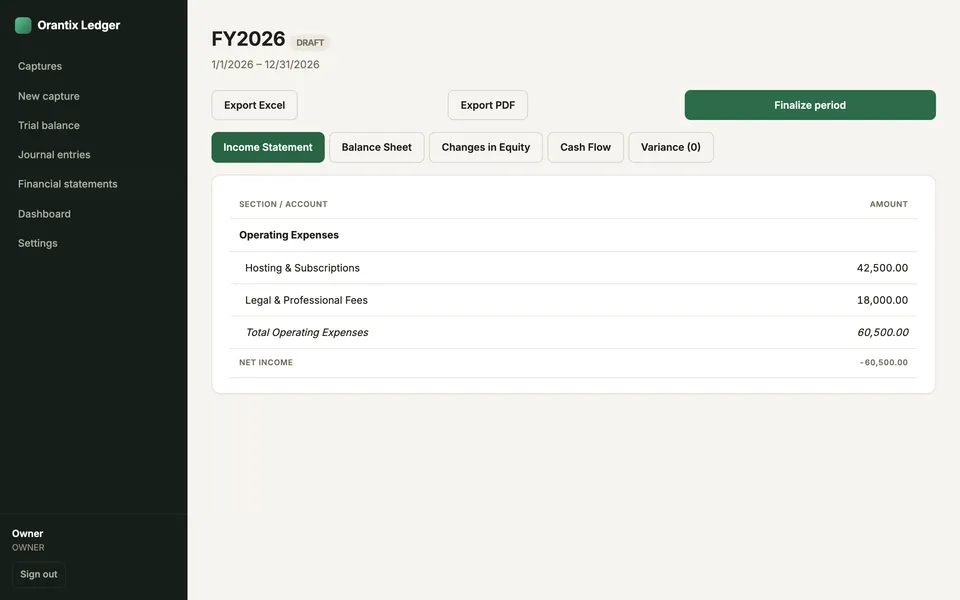
Income Statement, Balance Sheet, Statement of Changes in Equity, and a direct-method Cash Flow statement — generated straight from the ledger, exportable to Excel or PDF.
Nothing to reconcile
Statements, the owner dashboard, and reconciliation checks all read from the same journal. There's no separate system that can drift out of sync with the book.
Owner dashboard
Cash-basis cashflow, burn rate and runway, related-party balances, capital committed vs. paid in, budget vs. actual.
Self-hosted, AGPL-3.0
Runs on your own infrastructure via Docker Compose. Your books stay yours — the code is public under AGPL-3.0.
Get it
Clone it, run it, use it.
Ledger is open source and self-hosted. Grab the code on GitHub — the README covers running it with Docker Compose in a few commands.